Thaddeus Holownia

The Radio Canada International Portfolio 1977-2006

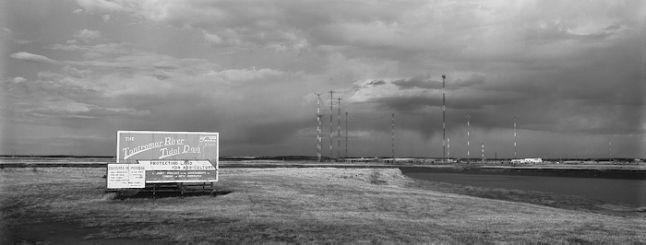
Canada decided, as early as the 1930’s, that its voice needed to be heard around the world. This need was bolstered in 1939 with the outbreak of war. A parliamentary commission set out to determine the feasibility of a short-wave radio service that could provide this voice. Radio Canada International was to be based in Montreal, but needed to find a location for the short-wave transmitting centre. Many studies concluded that Sackville, New Brunswick, would be the ideal location for the transmitters. Sackville, directly in the middle of Canada’s maritime provinces, was a perfect vantage point poised between the rest of Canada to the west, and Europe to the east. The salt marshes east of the town were very low and very flat, and the conductivity of the salt-steeped soil beneath the transmitters provided a powerful boost to outgoing signals.

Construction of the towers took nearly 29 months to build and test, and were eventually opened on February 25, 1945, with two 50 kW transmitters that would carry news to Europe in the dying days of the War.

Since moving to Sackville in 1977, Thaddeus Holownia has photographed this striking and changing landscape, whose flatness is dramatically punctuated by the short-wave towers, bursting perpendicular from the Tantramar Marsh. For 28 years of wild climactic cycles in this famous landscape, the towers have remained a stalwart constant — a benchmark for 60 years.